Why a second mechanic
The wheel gave players a reason to come back every day, but its prize was always free spins. That was a design choice: free spins are cheap, easy to cap and easy to control. They also have a limit. A player who wins free spins plays the games we choose, in the size we choose. For some players that is not much of a reward.
I wanted to test a different kind of reward: money the player can use as they like. A bonus with a low rollover is much closer to cash than a free spin. It gives the player freedom. The risk is obvious. Real money costs more per unit than free spins, and it attracts exactly the people the wheel was built to keep out. So the question was not “should we give money?” but “can we give money in a way where the player’s own play pays for it?”
The answer I settled on was to tie the prize to what the player had already generated. The vault is a piggy bank, a mechanic known from mobile games: a container fills while you play, and you open it later. In our version the player plays for several days, and at the end receives a bonus sized on their own net revenue to the house over that period. The more a player had contributed, the more the vault was worth. The prize is a cashback in spirit, and the rollover turns it into more play.
Black Friday was the natural first date. It is the biggest week of the year for the category, every competitor makes noise, and players expect offers. It was also a good place to test, because retention in that week was exactly what the vault was built for. The goals I wrote were two. The primary one was higher retention in Black Friday week and a higher average ticket. The secondary one was to find out whether a real-money prize could work as a recurring mechanic. I was clear with everyone that this was a test of a possible permanent feature, not a one-off promotion.
 The vault icon. It had two states, locked while the player accumulates and available when it was time to open.
How the vault works
The player accumulates for 10 days, and the vault opens on the Friday after. Accumulation ran from Tuesday 18 November to Thursday 27 November. On Friday 28 November at 5 pm the vault became available, and each player had 7 days to open it. If they did not, it expired. During the accumulation the vault was visible on the site, locked, with a countdown to Friday.
The bonus is worth about 10% of the player’s net revenue, with a 1x rollover. Net revenue is what the player generated for the house minus the bonuses we gave them. A player with a net revenue of 100 would receive a bonus of 10, which becomes withdrawable after the player wagers that same amount once in casino games. The player does not need to deposit, and the rule fits the same compliance line as the wheel: a reward for play that already happened, not a push to deposit.
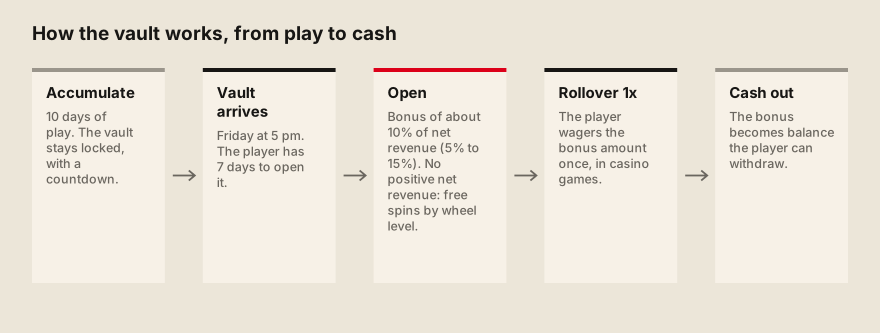 The path of one vault, from 10 days of play to money the player can withdraw.
The real prize ranges from about 5% to 15% of net revenue. We split the players into up to 100 groups by their net revenue in the period and took the median of each group, then multiplied it by 10%. Everyone in a group received the same value. A player who sat below the median of their group got more than 10% of their own net revenue, and one above got less. That is why the terms and the communication had to say the prize is a range.
Players without positive net revenue still got a vault, but with free spins. My estimate was that about one player in ten ends a period with negative net revenue. They had played, and leaving them with an empty vault would make the mechanic feel unfair. So they received a vault with free spins, sized by their level on the wheel, the same average amount a wheel at that level would give. Nobody got a bonus in money without having generated positive net revenue.
The vault does not grow on screen, and that was a deliberate decision. Early on we imagined a piggy bank that visibly fills. In a casino it cannot, because a player who wins reduces their own net revenue, and a vault that shrinks after a win is confusing and invites complaints. We could have filled it by turnover, but that would reward volume instead of net revenue and raise the risk for the house. So the vault sits locked, and the player learns the value only when it opens. This has a cost: it is harder to explain than a bar that fills. We accepted that cost.
How it differs from the wheel, and why
The wheel and the vault do different jobs. The wheel is a daily habit, small prizes, free spins, everyone included. The vault is a weekly event with a prize in real money that depends on how the player’s period went. I put the two next to each other because players compare them, and I wrote that into the risk list of the alignment document: players would compare values and notice differences. The mitigation was to say plainly that they are two mechanics with two goals.
| Wheel | Vault | |
|---|---|---|
| Rhythm | One spin a day | One vault after 10 days (later, a week) |
| Prize | Free spins | Bonus in money, with 1x rollover |
| Size | Set by the player’s tier | About 10% of net revenue, 5% to 15% |
| Who gets it | Every logged-in player | Everyone, with free spins if net revenue is not positive |
| Main goal | Daily return | Return across days and a higher ticket |
The rollover is part of the economics. A 1x rollover means the bonus is wagered once before it can be withdrawn. That play is turnover for the house, and it amortises part of the cost of the prize. For the player, 1x is a low bar compared with the usual bonus. I thought of it as a fair trade: more freedom than free spins, in exchange for some more play.
We could say “cashback”, but not a percentage. The vault behaves like a cashback and we could call it that. We could not announce “10% back”, because the real figure was a range, and a fixed number in an ad would become a promise we did not make. The terms and conditions say the prize is between 5% and 15% of net revenue. We also could not say that playing more makes the vault bigger, because the calculation uses net revenue, and a player who is winning gets less.
A dedicated terms document was required. The vault has its own rules for disqualification, expiry and the range of the prize. Compliance wrote a separate terms and conditions document for the campaign.
Many areas, one week
The vault needed almost every team in the company, and the kickoff was on 13 November, five days before accumulation began. I wrote the alignment document with one line per task and the area that owned it. Marketing named the mechanic. Creative made the key visual, the vault art in two states and the images for a landing page. CRM planned the communication across the period. The performance team evaluated paid media. Engineering built the landing page inside the promotions page and an optional countdown. Operations created the bonuses with rollover and registered the mechanic in the rewards platform. Compliance wrote the terms. Product, which was me, defined the net revenue groups, the eligibility logic, the metrics and the event tracking, and tested that the data pipeline could follow the campaign while it ran. Data was to prepare a follow-up dashboard.
Not everything was ready. Two items were still open when the doc was last updated: the support FAQ and the dashboard. Push notifications were off the table, because we could not yet segment the players who had a vault and send only to them. So the player learned about the vault from the site and the landing page, plus whatever CRM sent. That limit probably held the open rate down, though I could not measure by how much.
The risks I wrote down were mostly about expectation. A player may not understand why they did not get a money vault, or why the value is lower than they hoped. A player who does not open it before it expires may be frustrated. For both, the mitigation was clear communication, a detailed FAQ and several reminders. For cost, the risk was that distributing 8% to 10% of net revenue could hurt margin if many players took part, so the plan was to watch it in real time and leave room to adjust the percentage in future versions.
What the numbers said
Fewer than a quarter of the vaults sent were opened. The vault went out to a large part of the base, and 21% of those who got one opened it. Most players never claimed it. The first reading was disappointing. The second was that the open rate was the cost control: the money only leaves when someone opens. That detail comes back in the last section.
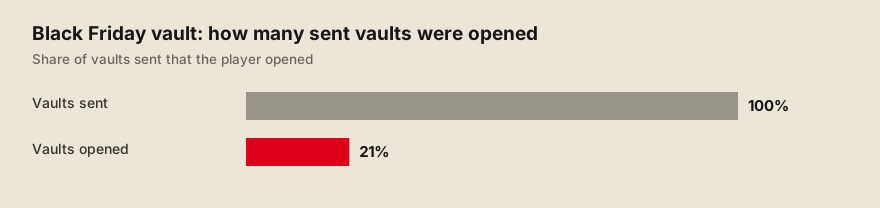 Share of the vaults sent that the player opened. Real percentages; absolute counts left out.
Black Friday week had more deposits than usual, and stickiness went up the week after. Deposits in that week were 14.3% above the average of the five weeks before, although Black Friday inflates every number, so I would not credit the vault with it. The cleaner signal was stickiness, which compares players active on two or more days in a week. In the week after Black Friday it rose by 8.8 percentage points. That is the effect the vault was built for, more days of play. This is a different measure from the stickiness in Part 2 (there, the share of days a player is active, +8.3 percentage points for the wheel), so the two numbers cannot be added or compared.
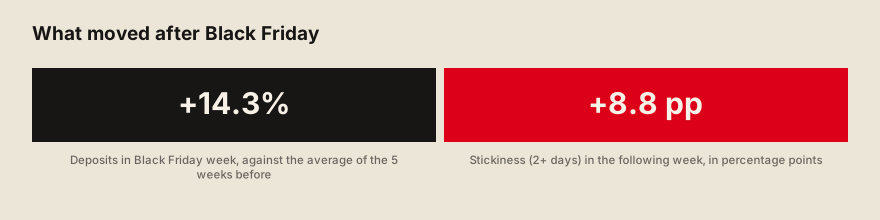 Two results from the Black Friday launch. The financial result in the period was not positive.
The financial result in that period was not positive, and I reported it that way. More days of play did not pay for the bonuses within the weeks we looked at. I did not hide that behind the stickiness number. The honest reading was that we had changed behaviour, and did not yet know whether the change would pay for itself. One test during a week where everything moves was not enough to decide either way.
So the decision was to run it weekly for at least four weeks. If stickiness is the product of the vault, a single event is the wrong way to measure it. A weekly rhythm would show whether the extra days of play turn into extra revenue over a month, and a month gives enough weeks to compare. That was the plan I took to the team in December. The weekly vault did start, and it ran into problems of its own.
From Black Friday to a weekly vault
The weekly vault, called Cofre Semanal, took the same idea and made it a routine. It goes out every Friday. The prize is calculated on gains and losses in the last 7 days, still around 10% of net revenue with a 1x rollover. Players who are bonus hunters, the people who only play to extract bonuses, are not eligible. The send window closes at 23:59 on Friday, and a player who had not received it by then was not eligible that week. The send was meant to run on Fridays at 11:00, earlier than the 5 pm of Black Friday. The bonus itself had to last 7 days, as we had promised players, which is what led to overlapping vaults in Part 5.
The first weekly run started on 19 December with a mechanism error that we fixed on 23 December. Then a mistake in the trigger sent three vaults in a row to the same players. I cover that incident, what it cost and what we changed in Part 5. I mention it here because it ended the clean four-week test. The four weeks I wanted to measure did not run cleanly in December, and I do not have the result of that test to show.
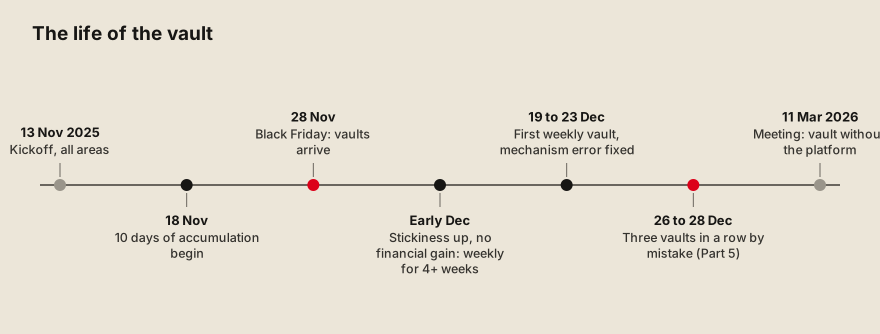 The vault in dates, from the kickoff to the meeting about running it without the rewards platform.
Running the vault without the rewards platform
In March 2026 the question was whether we could pay the vault as money straight into the account. The vault ran on the rewards platform: it sent the vault, the player opened it and the platform created a bonus with rollover in the betting platform. That path has costs and limits. The meeting I had with engineering in March asked whether we could replace the bonus with a direct deposit, calculated by our own data and paid by our own systems. One reason was financial: removing the bonus would remove the tax on bonuses, and the estimate was a large monthly saving. Another was control, because we would not depend on the rewards platform to deliver the prize.
The biggest risk was that paying automatically would multiply the cost. Today around 20% of players open the vault. If the money arrived in everyone’s account without an action, 100% would receive it. At the same amount per player, that is a cost five times higher. The rule that only the player who comes back to open the vault gets the money was doing a lot of quiet work. Take it away and the economics change completely. So the position in the meeting was that the player still has to tap a button to claim the money, and the week-long window to do it stays. That keeps the urgency and the cost under control.
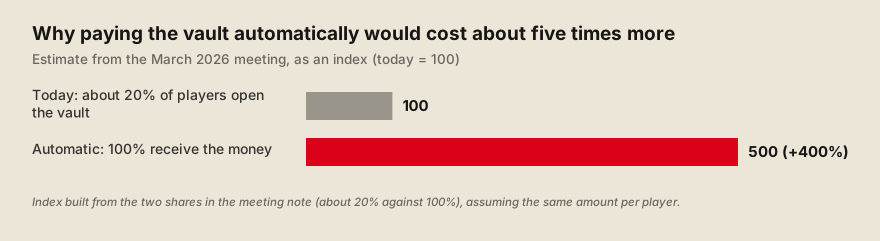 The cost of paying everyone automatically, as an index. The figures come from the two shares in the meeting note.
The plan we agreed was to start small and approve by hand. We would begin with the highest of the four levels of players, a very small group. The data team would feed a table every morning at 6 am, following the rules I wrote, with the amount of cashback calculated automatically. For the first group, a person would validate each payment before it went out. Open questions stayed open: the tax treatment, which I was to clarify with the finance and accounting people, whether the cycle would stay weekly or become daily, the cash needed to cover growing balances, the registration with the regulator’s system, and push notifications from CRM. The note ends with those next steps. I do not have a record of this version launching before I left, so I cannot say how it ended.
What I took from it
A reward in real money needs a cost brake, and here the brake was the player’s own action. The 21% open rate looked like a weakness and was also the thing that kept the cost low. When we considered removing it, the cost estimate told us not to.
Measure the behaviour you wanted, and say when it did not pay. The vault changed behaviour and did not show a financial gain in the period. I said so, and the right response was a longer test, not a better story. A mechanic can be good for the player and still need proof that it pays for itself.