The objective of this part is to show how the wheel changed after players spoke. It covers the first survey, the limits of what it proved, and the product decisions that came out of it. How the final effect was measured is in the part about measuring, so here I only repeat what the first test said.
Why I asked, and how
By August 2025 I had behavior data and no opinion data. The wheel was on for about 30% of active players. I could see visits, spins and deposits, but not whether people liked it or what they would change. Every next decision (wider rollout, new prizes, new tiers) needed that.
The first test had already said yes, in numbers. Compared with players who did not have the wheel, average ticket went up 17.7% and turnover per player about 12% once version 1 reached 30% of the base. That was enough to keep going. It was not enough to say what to improve, and it was a first read, not the causal study that came months later.
The survey was short on purpose. The plan was one email to everyone who had received at least one daily bonus, with four questions and under one minute to answer. Two were closed: a satisfaction score from 1 to 5, and one question about how they would feel if the wheel disappeared (very disappointed, a little disappointed, would not mind). Two were open: what they liked most and what they would change. As a thank you, everyone who answered got a small gift of free spins.
I borrowed the second question from product-market fit research. The common rule of thumb is that a product is in a good place when at least 40% of users would be very disappointed to lose it. It is a better signal than a satisfaction score, because people can be satisfied with something they would not miss.
I sized the sample and then ignored it. The plan said 400 to 500 answers would give a margin of error of about 5 points at 95% confidence. We got 2,541, about 7% of the players who had used the bonus. A second send was planned for those who did not answer. A smaller round of WhatsApp conversations through the support team was planned too, with 50 to 100 players in proportion to the deposit groups. I only have the plan for that one, not its notes, so I do not report anything from it.
What the first survey said
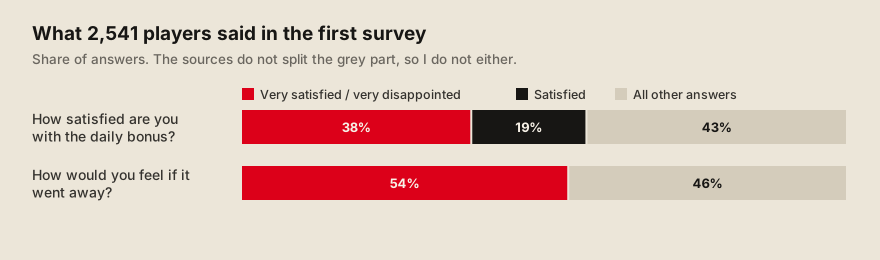 Satisfaction and “how would you feel without it” in the first survey. The grey part is everything else; I do not have the split.
Most people who answered liked it, and more than half would miss it. 38% were very satisfied and 19% satisfied, so 57% on the positive side. 54% said they would be very disappointed if the wheel went away. That is above the 40% rule of thumb, and it was the number that gave the wheel a place in the roadmap.
The open answers pointed to one thing: more spins. Players valued the number of spins more than the value of each one. A large share of the comments asked for more free spins, even if each was worth less, and the great majority asked for at least 10.
The survey had holes, and I knew them. Only people who had already received the bonus got the email, so nobody who had given up or never unlocked it was in the sample. People who answer surveys are usually the ones who feel strongly. And there was a gift for answering. I used the survey to choose a direction, not to measure how much players liked the wheel.
The survey tool taught me a lesson about identity. The tool needed the player’s identifier in the link to match each answer to an account. The version we could afford showed that identifier in a visible field, which meant the player could edit it. A hidden field would have cost more and I chose the cheaper one. In my notes from September the lesson is plain: we could not be sure who had answered. So the results were good for the overall direction, and not for any decision about a specific player. The records do not say what we did about the one complaint that came through the survey, so I will not guess.
What changed in the wheel
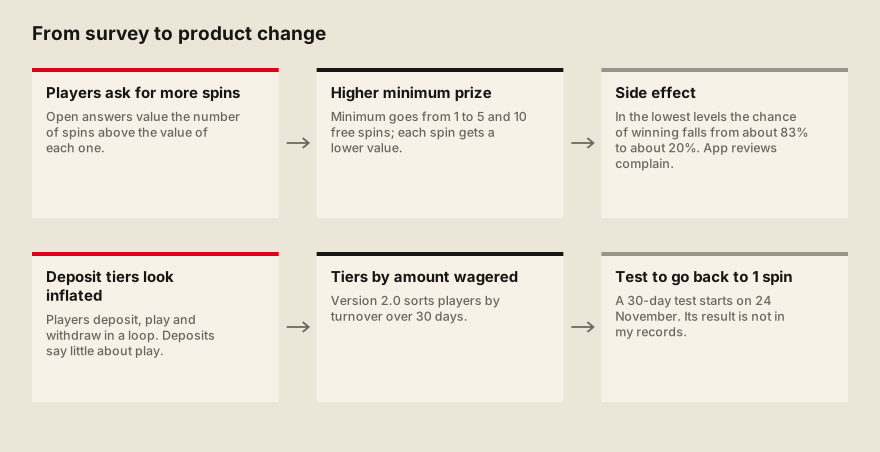 From finding to change. The right side of the second row is a test that was running when my records end.
The first change was the floor of the prize. In version 1 the lowest levels paid at least 1 free spin, and one slice paid nothing. With the weights I had, a player in those levels won something in about 83% of spins. The announcement of version 1.5 says the minimum went from 1 to 10. The later analysis says it more exactly: 5 on the three lowest levels and 10 from there up. Either way, the idea was the same: fewer ways to get a tiny prize, and each spin worth less.
Smaller spins made bigger numbers possible. The betting platform had just released a lower minimum bet, half the value of the old spin. Most wheels used it. The wheels for the highest-value players kept higher values per spin, because 10 or 160 spins at a tiny value would have made the game boring for them.
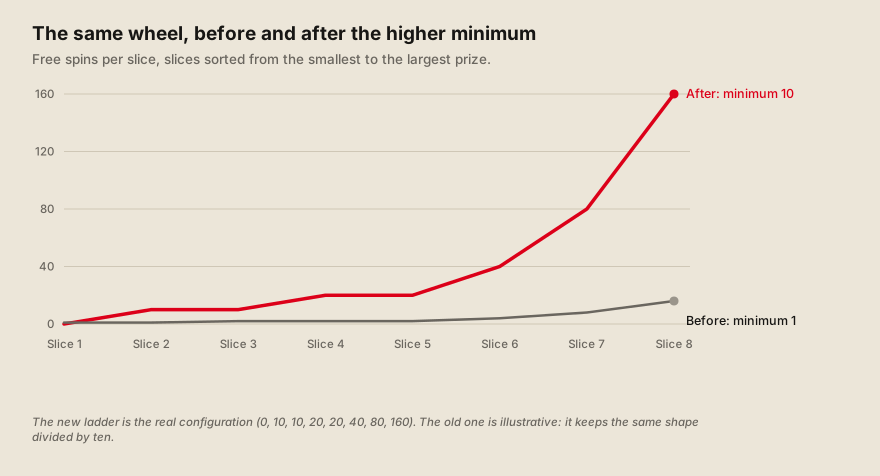 The same eight slices before and after. The new ladder is the real configuration; the old one is the same shape divided by ten.
The other half of the change was the economics. Part 1 has the detail: the budget moved from 5% of deposits to a share of gaming revenue, 10% and later 8% to 10%, which halved the cost and left room for another action, the weekly vault.
The higher minimum had a cost I did not weigh enough. To pay 5 or 10 spins instead of 1 and keep the budget, the lowest levels had to win less often. The chance of winning fell from about 83% to about 20%. Soon a series of app reviews complained that the wheel never gave anything, and in a 30-day comparison levels 2 and 3 lost performance.
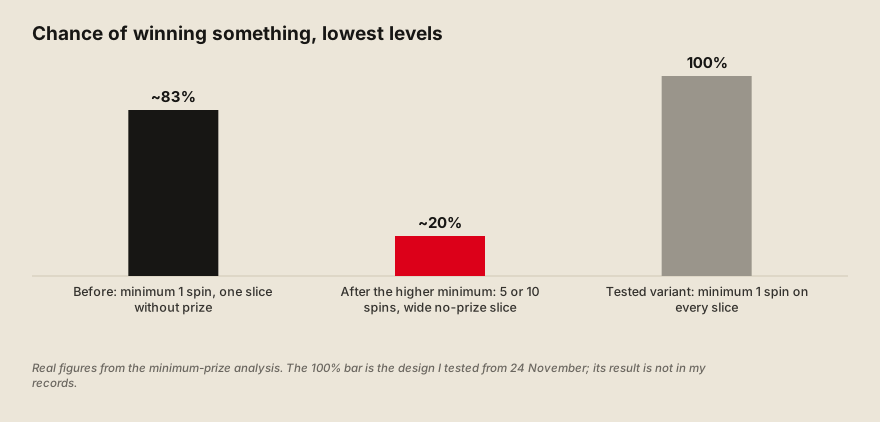 Chance of winning something in the lowest levels. The last bar is the test, not a result.
So I wrote a test to go back. The hypothesis was simple: if the minimum returns to 1 and every slice pays, the chance of winning becomes 100% with no extra cost, and the 30-day metrics improve while the complaints fall. The test ran from 24 November to 23 December, with half of the players in levels 1 to 5. I included more levels than the two that were hurting, to learn something broader: how wheels that do not always pay but pay more when they do compare with the opposite design. The main metric was a 30-day average per user, with stickiness among the secondary ones. I do not have the result in my records, so I do not report one.
The lesson is that a survey answer is not a design. Players said “more spins”. I heard “a high minimum”. They had not said “and make the wheel lose most of the time”. Asking again, which is what the second survey was for, was the honest way to check.
The tiers, and the weekly vault
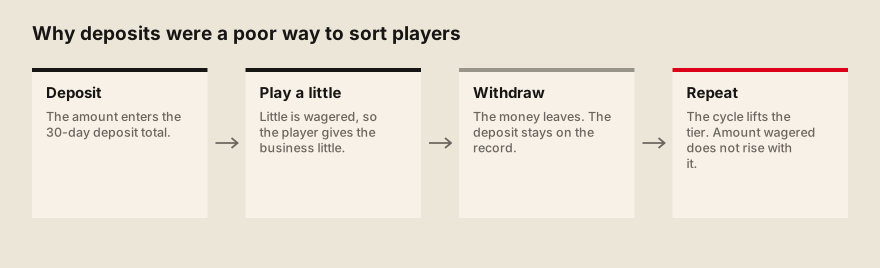 Why the deposit total said little about who was actually playing.
Deposits were a poor way to sort players. Some players deposited, played a little, withdrew and repeated the cycle, and each loop pushed them into a higher tier with bigger prizes, although the money they wagered did not match. Part 1 tells how the tiers moved to amount wagered and why I did not sort by profit.
Not everyone agreed, and that shaped the design. In a meeting with commercial leadership the worry was giving bonuses only to players who generated revenue in the very short term. There was also a good point about cashback: when one operator offers it, others must beat it, and everyone loses. I defended two things: keep the wheel next to anything new, and test the minimum instead of settling it in a meeting. They found 400 free spins excessive. I answered that if we can give more spins we should, and that this was worth a test. Later we set the top prize at 160 on every wheel.
The weekly vault came from the same discussion. We first called it the chest. The idea was a weekly reward for players who had generated positive revenue in the previous seven days, with a value calculated for each one, waiting for the player with no need to log in at a given moment. It was planned for 26 September and later became the Black Friday vault. Part 4 tells it in full, with the results.
What I considered for daily rewards, and what I left out
I looked at how other games reward daily logins and picked what fit. The first document already listed the patterns. What I took: a reward that expires every day, so there is no hoarding; a reward that is always given, mostly the smallest prize, with small chances of more; a fixed time, from 17h; and levels with their own wheels, which became the bronze to platinum VIP wheels in November. Wheels for holidays and partner campaigns stayed as ideas, not as work.
I left out streaks, and wrote down why. A larger reward for each day in a row is common in mobile games. It works until someone misses a day, and those players tend to give up. It also depended on the rewards platform supporting it, so it stayed on the list for the 2026 plan.
There was a gap for new players, and a popup closed it. The popup itself is shown in Part 1. A new player had to deposit, finish the identity check and wait until the next day to receive the first spin, and nothing told them that they had unlocked it. We designed two popups in the style of mobile games, shown eight seconds after sign-up and after the last requirement is done, once per player, with a button to close and a link to download the app for people on Android in the browser.
The popup had its own success rules. More than 95% of qualified players should see it, tracking had to work, and there could be no complaints of intrusive popups. The plan was to release to 5% of players first to check performance and then go to 50%. I do not have the outcome in my records.
The second survey was written to check the changes. I wrote it in November, three months after the first one and in a very different context: the wheel was now for everyone, with VIP wheels, turnover tiers, stronger protections, a lower budget and the dashboards to change the composition of each wheel. It had 11 questions and aimed for 10,000 answers. It asked about game choice, minimum and maximum prizes against the chance of winning, 160 against 500 spins, what mattered most, how players heard about the wheel, and how it compared with other platforms. I did not keep the answers in my records, so I cannot tell what it found. What I can say is that the design of that survey shows what I did not yet know: whether players wanted the same wheel I had built.