Why a wheel first
The gap was frequency, not traffic. In the baseline I used for the 2026 plan, about 8% of H2Bet’s monthly players were active on a given day (the metric is called DAU/MAU). The mobile games I used as a reference sit around 31%. Day-1 retention was 14%. Buying players was getting more expensive, and the casino catalog was the same as everyone else’s. What we could still control was the layer around the games: the reason to open the site tomorrow.
A daily reward is the oldest answer to that question. An industry report said that among the top 1,000 mobile games by revenue, the ones with a daily bonus earned 12 times more than the ones without. I never treated that as a promise, because it is a correlation. I used it to see that a daily reward is a minimum standard in games, and H2Bet did not have one. When I mapped the market, H2Bet had four mechanics against eight to eleven at the direct competitors.
One mechanic that stays on beats a program that takes a year. Levels, missions and streaks were all on my list. Levels in particular need a delicate balance between easy first steps and harder later ones, and that takes many rounds to get right. The wheel could be built on the rewards platform we already had, and it gave us one recurring action that was always live and always teaching us something. From the first plan to the wheel reaching every player it took five months, counting development, the test and the gradual rollout. If every mechanic took three months, the 21 on my map would take more than five years. I needed a first mechanic that was quick to learn from.
A wheel is also the cheapest way to touch every player every day. A mission asks the player to do something. A wheel asks the player to open the app, which is the smaller ask and the one that reaches the whole base. And it gives me a daily moment where a vault or a welcome offer could plug in later. Two of those came later in this story.
How one spin works for the player
Everyone who is logged in and eligible gets one spin a day. The wheel arrives around 5 pm. The player opens it, spins once and wins free spins in selected casino games. A spin that is not used expires at the end of the day. That is on purpose: it blocks hoarding and makes the wheel a reason to come back today.
The prize is always free spins, in games I chose. Free spins need a game that is connected to our infrastructure, which in practice meant the catalogs of two providers. I picked low-volatility games with the smallest bet the platform allowed, so a player has a fair chance of seeing a win.
The wheel has eight slices, the number the rewards platform supports. The platform let me set the odds of each slice and attach a bonus to it, and not change the number of slices. Most of the design work was in the odds.
 An early wheel. Slices of 5, 10 and 20 free spins, and slices that said “foi por pouco”, which means “close one”.
The first plan was to always pay, and the numbers said no. I wanted every spin to win something, because a wheel that often says no feels like a trick. But in the cost model the smallest players could not afford even one free spin a day. So the lowest levels got a no-prize slice. I came back to that decision twice, after the first survey and after complaints in the app store reviews. Both stories are in later parts.
For a new player, the wheel is something you unlock. Someone who had just opened an account was in no level yet. They had to make a first deposit (any amount), finish the identity check and wait for the next day, and nothing told them they had got there. In October I wrote the brief for two mobile-game style popups, with the details in Part 3: one after sign-up, saying the daily spin can be unlocked by playing with us, and one when the conditions were met, saying the first spin is available the next day at 5 pm.
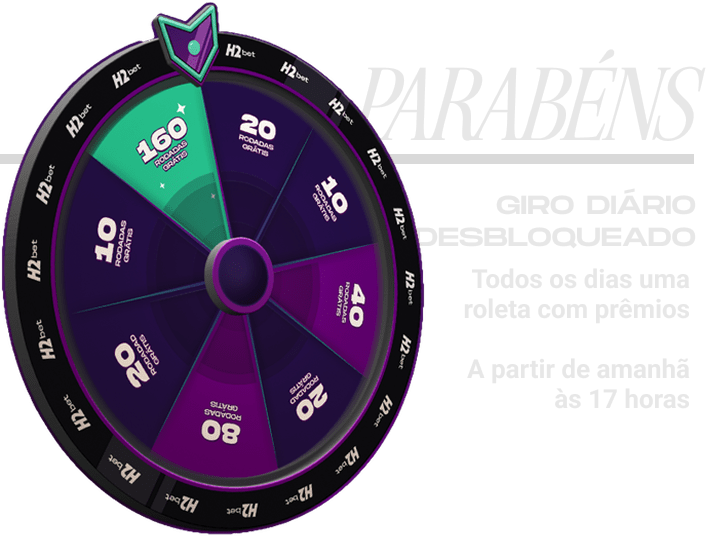 The unlock popup. It says the daily spin is unlocked and that the first one arrives the next day at 5 pm.
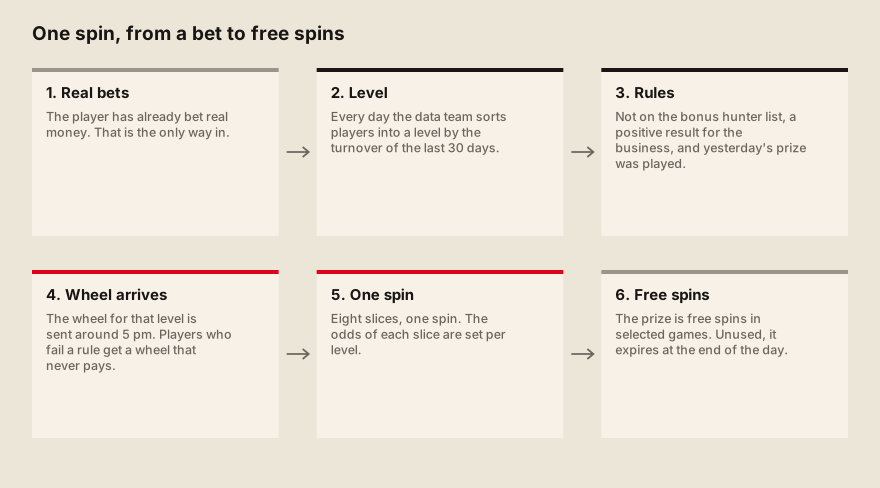 What happens between a bet and a prize. Steps 1 to 3 run every day in the data team’s pipeline, before the player sees anything.
Levels: from deposits to turnover
A wheel that pays everyone the same would be wrong in both directions. A prize of a few cents insults a player who bets a lot. A big prize costs more than a small player brings. So the wheel had to be a family of wheels, and the first question was how to group players.
Version 1 grouped players by how much they had deposited in the last 90 days. I followed the data team’s segmentation by recency, frequency and value: eight groups, from the smallest depositors to the top 100 customers. The wheel started with a share of the base and grew to 30%. The prize size went up with the group, and so did the weekly limit on free spins.
In September I changed the window from 90 days to 30, and then the measure itself. The business moves fast, and 90 days kept players in a level long after their behavior had changed. Then came the bigger change. For a few weeks two versions ran side by side: version 1.5 for most of the base, still on deposits but over 30 days, and version 2.0 for the rest, on turnover, which is the total amount wagered. In mid-October every player moved to the turnover rule.
Deposits were a noisy signal, and turnover was not. Many players deposit, play and withdraw in a loop, and deposits counted every pass of that loop. That inflated the numbers and added noise to my analysis. Turnover counts only money that was actually played.
I considered grouping by profit and decided against it. Net revenue, what the business keeps after prizes, was an obvious candidate. I did not want to treat winners differently, because winning is part of the business and I wanted a long relationship with those players too. What I added instead was a narrower rule, from 14 October: a wheel that pays goes only to players with a positive net result for the business. The others get a wheel that never pays. It only decides who receives money.
The ladder has eight levels plus four VIP tiers, and each level asks for 2.5 to 5 times the turnover of the one below. The VIP tiers (bronze, silver, gold and platinum) have wheels of their own. Two more wheels sit outside the ladder and never pay. Level 0 is a fallback for players with no turnover in the last 30 days, a negative net result or an unplayed bonus from the day before. The other is for bonus hunters, described below.
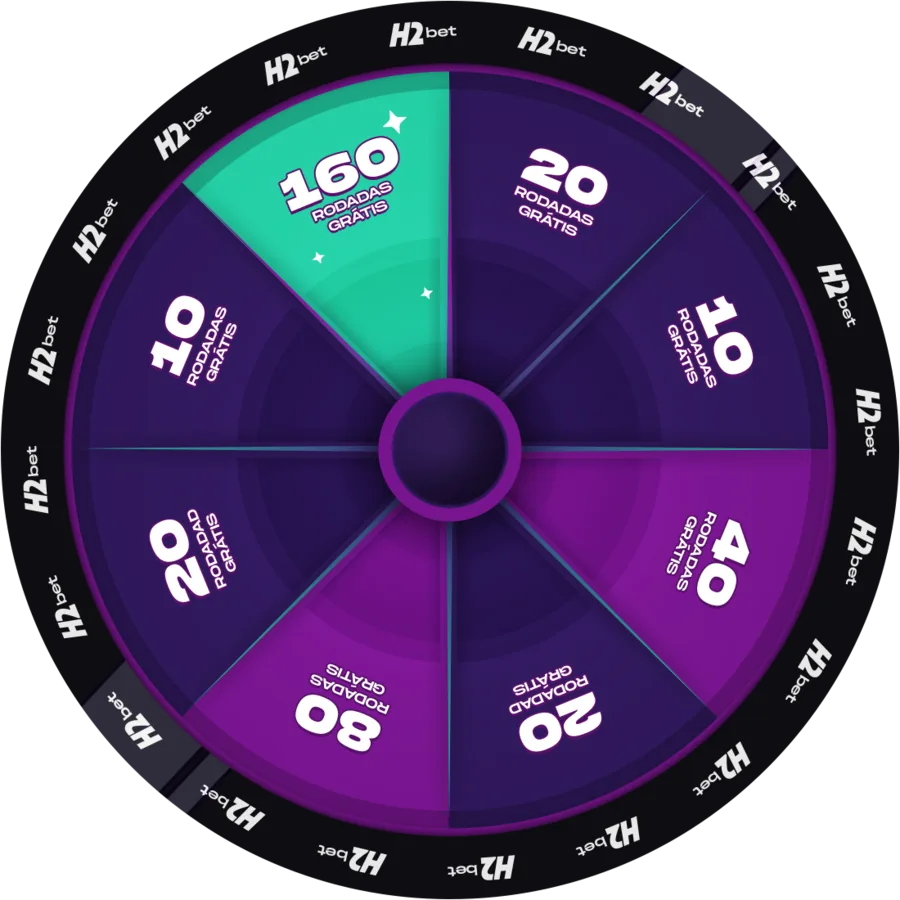 A wheel from the later version. The slices are 10, 20, 40, 80 and 160 free spins. What changes from level to level is the value of each free spin and the odds of each slice.
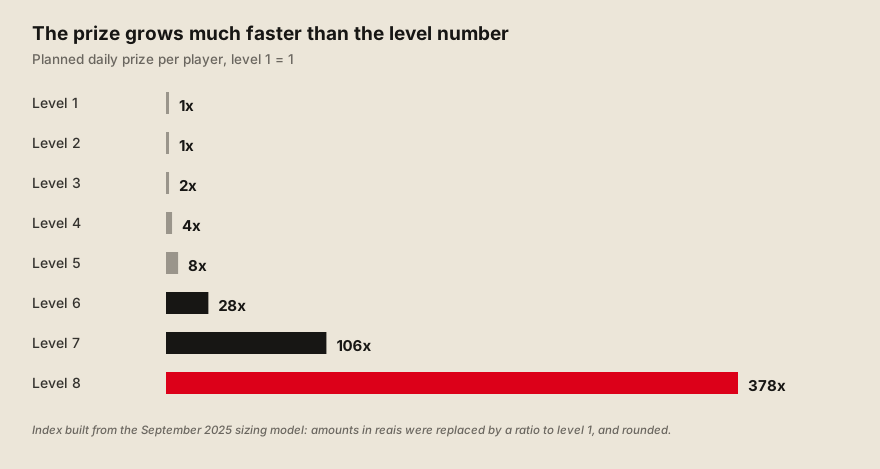 The planned daily prize per player, as a multiple of level 1. The steps follow how much each level is expected to bring in.
The prize grows far faster than the level number. The wheels share the same kind of slices, from 10 up to 160 free spins. What moves with the level is the value of each free spin and the odds of each slice. A player at level 8 was planned to receive about 378 times what a player at level 1 gets. The next charts show why that is not as extreme as it looks.
A budget that follows revenue
I set the budget from what each level brings in. In the first model I took the total deposited by each group, divided it by its active players to get an average ticket, applied a fixed percentage as a daily rakeback (a share handed back to players) and divided by 30. That gave the daily prize each group could afford. In version 1 the percentage was 5% of deposits.
The first model showed that paying everyone had a price, and the price was in the small levels. Laid over the expected revenue of each group, the planned bonus came to 12% to 21% in the three smallest groups and 3% to 5% in the big ones. Overall it was 4.7%, under the internal ceiling of 6% for this kind of incentive. A free spin at the median bet of the smallest groups was worth more than the daily share they could pay for. I had decided the wheel should not skip anyone, so I raised their prize to the median bet and accepted that the small levels cost the most relative to what they bring.
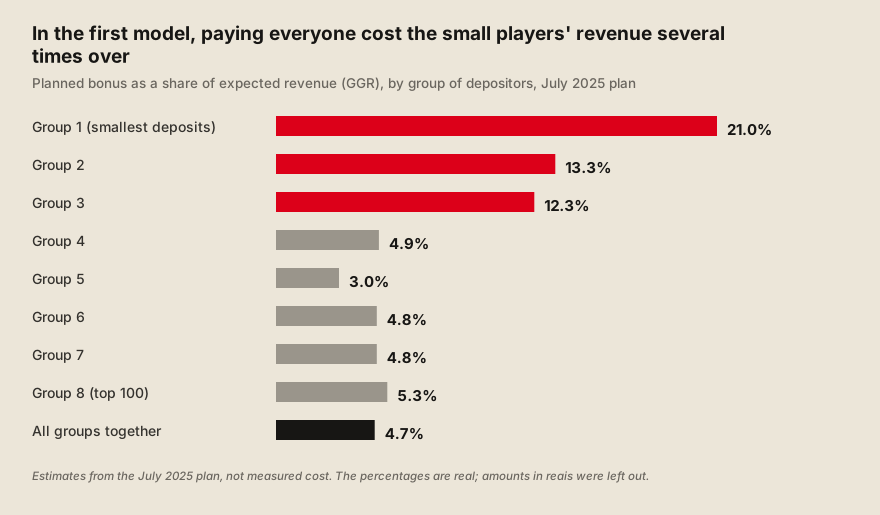 The first model, from the July 2025 plan. These are estimates of what the wheel would cost, not measured spend.
The month’s budget came from the revenue of the month before. I recommended that base because it gives a cushion against crossing the ceiling. The first test was small too: new players for a month, with a cap on the total bonus handed out.
Version 2 changed the logic from deposits to revenue, and halved the cost. Version 1.5 had been calculated at 5% of the average deposit of each level, which was around 20% of the revenue. Version 2.0 sized the rakeback on the average gaming revenue instead, at 10%. That opened room for a new activity, the weekly vault, covered in a later part. In December levels 1 to 5 were on 10% and levels 6 to 8 and the VIPs on 8%.
Rakeback gives the paper value of the prizes, and the real cost can differ. The compliance notes made this point, and it matters for every number above. A free spin has almost no cost when it is granted. The cost appears only if the player wins and the win is paid out, after any wagering requirement. A cash bonus is a liability from the day it is granted. Free spins also carry fees: the betting platform’s, the game provider’s and the cost of withdrawal. So the budget was a ceiling on the nominal value of prizes, and the real cost had to be watched on what was granted and paid.
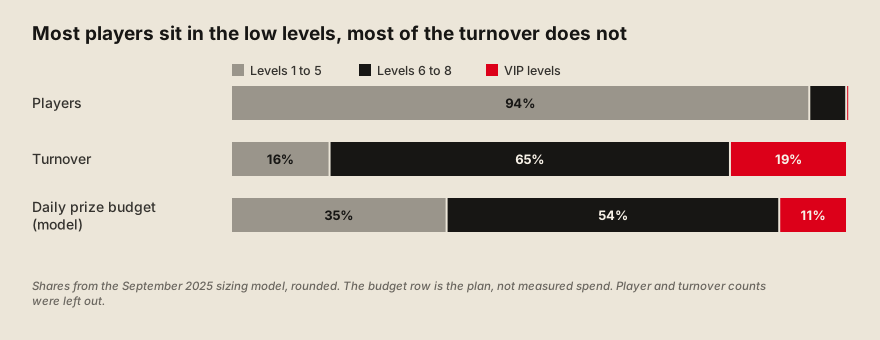 Where the players, the turnover and the planned prize budget sit across the ladder.
Most players are in the low levels, and most of the money is not. Levels 1 to 5 hold about 94% of the players and about 16% of the turnover. Levels 6 to 8 hold about 6% of the players and about 65% of the turnover. The VIP tiers are about a tenth of a percent of the players and about 19% of the turnover. The planned prize budget put 35% in the low levels, because they are so many, 54% in levels 6 to 8 and 11% in the VIP tiers. I accepted that: a wheel that skipped the many would not be a daily habit for the base.
In December I set a watch ceiling of 3% for bonus over revenue. I asked the data team for one indicator at the top of the cost page of the dashboard: total bonus over revenue. That is the number I steered by. I also wrote a test of how sensitive players are to the size of the rakeback, with variants 50% above and below the current one, balanced so the total cost stayed the same. I have no result from it to report, and I will not guess one.
Keeping bonus hunters out of the paying wheels
A free daily prize attracts people who want only the prize. Some accounts exist to collect free spins and never play with real money. If they got paying wheels, the budget above would be spent on the wrong people.
Version 1 had a rule written for this. A player who had deposited in the last 90 days, had not deposited or bet in the last 7 and had still received four or more free spins that week was treated as a hunter and left out of the paying wheels.
Every level has a weekly cap on free spins. A player who had received more than the cap in the last seven days did not enter the wheel. The cap grew with the level, from four free spins a week at the bottom to a couple of hundred for the top 100. The weekly view mattered more than the daily one, because a hunter can look harmless on any single day.
A prize that was not played blocks the next one. From version 1.5 on, a player who won a bonus the day before and did nothing with it does not get a paying wheel. Either the bonus generated turnover, or no wheel pays that day. It is the closest thing in the design to a habit check: you play what you win.
In September the data team built a proper bonus hunter list, and I moved the rules onto it. Players on it still receive a wheel, but it always lands on the “not this time” slice. The level 0 wheel works the same way, and it gave us visibility on a group we knew little about, such as players CRM had reactivated after 30 days without turnover.
The rules that were written into the design
The compliance rules sit next to the economics in the same document. The foundations document said every mechanic is validated with compliance. For the wheel, compliance sent me a list of points, and I kept it as an annex of the document that proposed the wheel. It worked as the spec.
Rewards only for players who already bet real money. The rule forbids any early advantage given to encourage betting, so nothing can be used to acquire a player at sign-up or first deposit. The wheel is for customers who have already placed at least one real-money bet.
No reward sold for a deposit, and no prize sized by one. The wheel was never offered in exchange for a deposit and there was no minimum deposit. I should be plain about three limits to that. A new player needed a first deposit and an identity check before the first spin, because that is the only way to bet real money. I treated it as a precondition and never as a price. The first versions also sorted players by what they had deposited, so the size of the daily prize did follow past deposits until the turnover rule replaced them. And the welcome wheel in Part 6 sizes its prize on the first deposit, which is why it needed compliance’s confirmation before launch. From the turnover rule on, the daily level follows what a person played in the last 30 days, not what they paid in. My own line, which I used in every review, was shorter: no tactics that push people to deposit.
No urgency messages. Compliance warned against calls to action like “last chance” or “do it now or lose it”. The wheel itself is in tension with this rule, because the spin expires at the end of the day. My decision was that the mechanic could expire and the copy could not pressure. The popups say what is available and when. They never say what the player will lose.
The same signals that segment players can flag problems. Compliance reminded me that recency, frequency and value patterns can show a player escalating into problem gambling, and my segmentation was built from those patterns. I kept that in mind when I chose the weekly caps. Advertising also had to carry the legal notices (play responsibly, 18+, the license number) and be easy to recognize as coming from a betting operator.
The cost formula follows what is planned and what is granted, not the number of active players. Compliance asked for the estimate to rest on planned free spins and bonuses, and for the settlement to rest on those actually delivered. I kept my model with active players as a sizing tool and tracked the real bonus over revenue in the dashboard.
Sending the wheels without breaking the platform
The wheel goes out as one send per segment. Each level has its own wheel and its own activity on the rewards platform, and each activity hands a wheel to a whole segment at once. Counting the levels of the two versions, the fallback wheel and the hunter wheel, there were 17 routines to fire every day.
The launch to everyone showed the limit. In mid-September I launched versions 1.5 and 2.0 and took the wheel from 30% of the base to 100% in the same afternoon. The rewards platform struggled and deliveries wobbled for a while. Its support team found the cause quickly and asked us to space the sends while they worked on it. Part 5 has the other side of that day.
The fix was to space the sends and warn the platform. They asked for a one-minute gap between routines. I rescheduled the 17 sends to every 3 minutes, from 4 pm until around 5 pm, so every wheel is ready when the day’s window opens. The version 2.0 activities were also set to start at 3:30 pm. And I made two rules for myself: always leave a gap between sends, and warn the platform before any big increase in use.
What I took from it. The rollout in steps of 5%, 10% and 30% had taught me about players and nothing about the platform at 100%, because full volume is a different kind of load. After this day, “what does this launch do to the platform?” went into every launch plan, next to “what does it do to the budget?”.
What this part taught me
The budget has to be designed before launch. The wheel could be cheap because I tied the prize of each level to the revenue of that level before the first player saw it. The weekly cap and the hunter rules were in the first version, and the compliance limits made the product narrower and easier to defend.
What I did not solve. The small levels remain the most expensive part of the wheel relative to what they bring. I made that trade on purpose and kept measuring it. The measurement of that cost, and of what the wheel returned, is in the next part.